
Third Eye Social: AI Agency Website Design on WordPress
A bold, dark-themed website for an AI automation agency that helps businesses deploy AI agents across sales, support, finance, HR and operations.
About the client
Third Eye Social builds AI agents that automate repetitive work for mid-size and large businesses in healthcare, finance, insurance, manufacturing, real estate and e-commerce.
What the website needed to do
- Explain a complex offer (AI agents) simply to business decision-makers
- Show the range of agent types and industry use cases
- Build credibility with case studies and client testimonials
- Turn visitors into booked calls
What I built
- Striking dark design with orange accents and animated headline treatment
- Use case sections for each agent type: customer service, sales, finance, HR, legal, marketing and lead generation
- Case study cards and client testimonials
- FAQ section addressing common concerns about adopting AI
- Insights (blog) section for thought leadership
- "Book a Call" calls to action throughout, plus WhatsApp
The problem
An AI automation agency had a technical offer that most operations heads find hard to picture, and needed a website that explained AI agents simply and turned visitors into booked calls.
How the site is organised
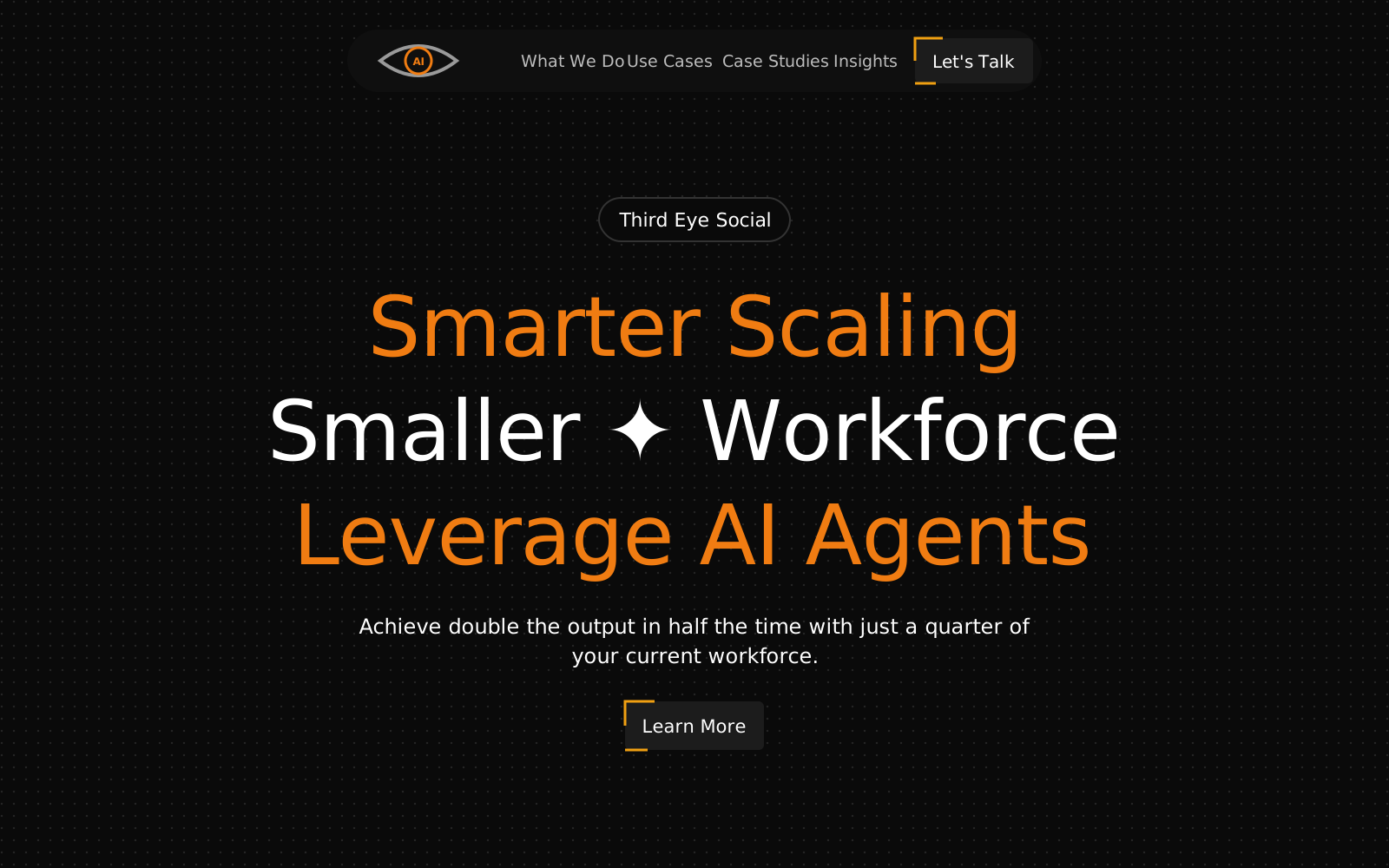
The site is one long homepage with four menu items, What We Do, Use Cases, Case Studies and Insights, each jumping to its own section. The hero leads with the outcome rather than the technology, "Smarter Scaling, Smaller Workforce, Leverage AI Agents", followed by a promise of double the output in half the time. The page then runs through the agent types, the company's mission, recent automations, case studies, testimonials, a FAQ and recent articles, and closes with "Let's Build Your AI Workforce".
Case studies and articles are the only separate pages. Each case study has its own URL and a heading that names the process and the type of client: vendor onboarding for an LED lights manufacturing plant, loan application processing for an NBFC in Delhi, and claims processing for a hospital in Bangalore. Each one ends with links to the other case studies and the same closing call to action.
Explaining AI agents to business decision-makers
"AI agent" means little to most operations heads, so the What We Do section, headed "Automating tasks, one industry at a time", breaks the offer into twelve agent types: problem solver, customer service, insurance, operations, sales, finance, management, HR, legal, marketing, healthcare and lead generation. Each card has an animated illustration and one line on the work the agent takes over, such as ticketing and drafting replies for customer service, invoice processing and expense tracking for finance, or screening candidates and scheduling interviews for HR.
The cards also name the software each agent works with: Zendesk, Freshdesk and Intercom for customer service, HubSpot, Salesforce and Pipedrive for sales, SAP, Oracle and Airtable for operations, and QuickBooks, Xero and NetSuite for finance. A decision-maker can see straight away whether the tools their team already uses are on the list, which is one of the first practical questions about bringing in AI.
A "Recent Automations" strip then names jobs the agency says it has implemented, including vendor onboarding, loan processing, complaint management, insurance requests and replacement management. These turn abstract agent types into processes a reader recognises from their own business.
Proof, objections and booking a call
Every case study follows the same structure: a "Key Outcomes" summary first, then the challenge, the solution, implementation details, the results and a conclusion. The vendor onboarding study, for example, explains how separate contract, compliance and setup agents divide the work, and sets out the implementation phases from design to staff training. A sceptical buyer gets the headline figures on the first screen and the detail underneath.
Each testimonial gives the person's name and company, including Kailash Hospitals, Vansh Electromechanical Devices and Rare Rabbit, and the founder adds a short quote of his own. The FAQ takes on the objections a cautious business raises: whether agents are hard to integrate for a company that is not tech-savvy, how they reduce operating costs, how they handle lead generation and follow-ups, how to make sure an agent follows the right instructions, and how to tell whether agents suit a particular business.
Every route ends in a conversation. "Book A Call", "Let's Talk" and "Reach Out" buttons appear throughout the page, and the booking buttons open a WhatsApp chat, so a visitor can start talking to the team from a phone without filling in a form. For readers who want more depth first, the Insights section has articles on subjects such as OpenAI's Operator and the differences between RAG, Graph RAG and KAG.
What other agencies and B2B service firms can take from this
If your offer is technical, break it into the jobs it does for each department and name the software it connects to. That tells a buyer more than a paragraph about capabilities. Lead with the business outcome in the headline and leave the technical detail to the cards and case studies.
Write every case study in the same order, with outcomes first, and give each one its own page with the client type and the process in the heading. Answer integration and control worries in a FAQ, and if your buyers are happy to chat, let "Book a Call" open WhatsApp. This site does that with WordPress, Elementor, the Hello Elementor theme and Yoast SEO.
The result
The live site now explains twelve agent types with the software each one works with, gives each case study its own page with outcomes first, answers adoption worries in a FAQ, and sends every "Book A Call" button to a WhatsApp chat.
Want something similar?
If you want a AI Automation Agency website like this on WordPress, see the WordPress development for agencies page linked below, or send a short brief through the contact form at the bottom of this page. You get a free review of your current site and a fixed quote before any work starts.
Related reading
- How to Write Case Studies for Your Business Website: A Section-by-Section Template, Honest Results, Client Permission, Formats and SEO
- FAQ SEO: How to Write FAQ Pages and FAQs for SEO on Service, Sales and Local Pages
- How to Add WhatsApp to Your Business Website: Click-to-Chat Links, Buttons, Tracking and the API
Let's build your next website
Available for freelance projects, agency white-label work and long-term maintenance. Feel free to pass this along to your team or company.