Building a solar or power company website, in detail
Rooftop solar buyers research savings, subsidies and installers for a long time before they ask for a site survey, and businesses buying inverters, gensets or electrical work compare suppliers on capacity and proof. This is how I plan and build websites for solar installers, power solution providers, generator hire companies and electrical contractors in India: solution pages, subsidy information, quote forms, project proof and local search. The solar company website guide covers what buyers want to know.
A solar or power website project, step by step
- Free review and a fixed quote. Send your current site or listings, your products and services, and the cities or districts you cover.
- Page plan. Residential, housing society and commercial solar, plus inverters, batteries, gensets or electrical services, each with its own page where the buyer is different.
- Content gathering. Datasheets, the brands you are authorised for, completed projects with photos, certifications and the subsidy process as you handle it.
- Build on staging. Solution templates, quote forms, a projects section and service area pages at a private address.
- Testing. Test quote requests sent to your sales team, any calculator checked against your own figures, and every page tested on phones.
- Launch and walkthrough. Search Console connected, your Google Business Profile linked, and a call showing your team how to add a project.
Justdial or IndiaMART listing, or your own website?
| Listings such as Justdial or IndiaMART | Your own website | |
|---|---|---|
| Leads | Often sent to several suppliers at once | Come only to you |
| Explaining subsidy, sizing and process | A short profile and product photos | A full page for each solution, with FAQs |
| Proof of work | A limited gallery | Project pages with capacity, location and photos |
| Lead details | A name, a number and sometimes a requirement line | Bill amount, roof type, connection and location from your own form |
| Cost | Paid packages for better visibility | The build, then hosting and upkeep |
Listings bring reach, especially for B2B power equipment. Your website is where people who already know your name, or find you on Google Maps, decide whether you are worth calling.
Solution pages written for buyers, not engineers
Separate pages for separate buyers
A homeowner, a housing society secretary and a factory's maintenance head ask different questions, so each gets a page: rooftop solar for homes (savings, subsidy, net metering, roof space), housing societies (common-area loads and committee approval) and commercial and industrial systems (capacity, payback assumptions, monitoring and AMC). Inverters, batteries and gensets are grouped by the backup or load they serve rather than by model number; websites for inverter and battery dealers explains why.
Organise equipment the way buyers specify it
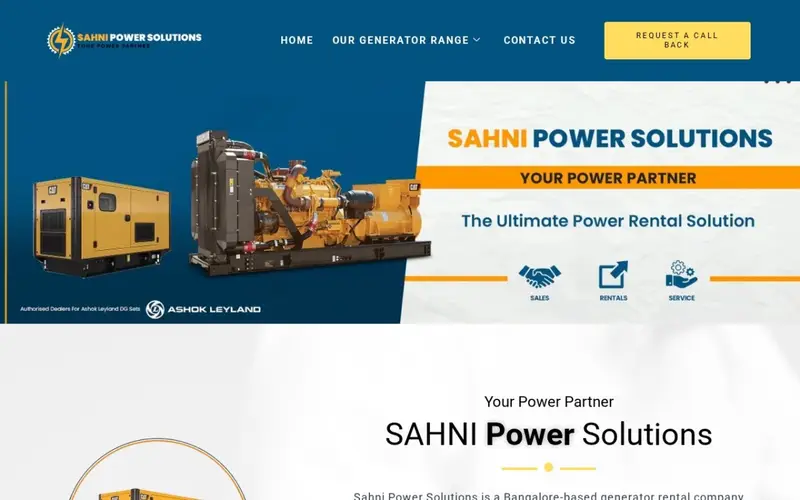
Sahni Power Solutions, a diesel generator rental company I built a website for, splits its fleet into seven capacity bands, each with its own page. The 82.5 to 125 kVA page lists typical uses, from small industries and hospitals to party halls, explains what affects the rental price (hire duration, fuel arrangement, whether an operator is included and the distance from its yard) and compares 100 kVA with 125 kVA for a small hospital. A solar company can do the same with system sizes: one page for home systems of a few kilowatts, another for society or commercial capacities, each answering that size's own questions.
Subsidy, net metering and honest savings figures
Home buyers ask about the PM Surya Ghar subsidy and net metering before almost anything else. I build a page that explains the process as you handle it: the application on the national portal, DISCOM feasibility approval, installation, the net meter and inspection, then the subsidy release. Amounts and eligibility change, so the page links to the official portal and dates any figures it shows, and it mentions DISCOM empanelment or registered vendor status only if you hold it. Net metering rules vary by state, so name the DISCOMs you work with.
A savings calculator helps people judge whether solar suits them, as long as every result is labelled an estimate, the assumptions such as generation per kilowatt and tariff are shown, and the figures come from you. Website calculators for lead generation covers how to build one honestly.
Quote forms, proof and compliance
The quote form asks for what your team needs to prepare a meaningful proposal, and no more at first:
- Property type (home, housing society, shop or factory) and city or PIN code.
- Average monthly electricity bill or sanctioned load, and single or three-phase connection.
- Roof type, such as RCC or tin shed, and shadow-free area if known.
- Interest in the subsidy, and a preferred callback time.
I keep an electricity bill upload optional, or leave it to WhatsApp once a conversation has started, because bills carry the consumer number and address. Generator and equipment enquiries suit a "Request a Call Back" button in the header and an "Enquire Now" button at the end of each section, as on Sahni Power Solutions. For proof, show completed projects with capacity, location and photos taken with the customer's permission, certifications with their numbers, and compliance where buyers need it: Sahni Power Solutions states CPCB-IV+ emission standards and Karnataka State Pollution Control Board noise limits for its silent units. Name brands only where you are authorised.
Local SEO for solar installers and generator hire
Most of these businesses travel to the customer, so they work as service-area businesses: a Google Business Profile with service areas, and no public address if customers do not visit you, the same name and phone everywhere, and pages for the cities or districts you genuinely serve, each with projects and details from that area rather than copies with the name swapped. Sahni Power Solutions names Bangalore localities such as Whitefield, Electronic City, Peenya and Hebbal in its FAQ alongside Pan India service, in the words people search with. LocalBusiness schema, with Service markup on solution pages, confirms what you do and where. SEO for service-area businesses explains the setup, and WordPress SEO services covers search work after launch.
What is included, and what is not
The list near the top of this page is what every solar or power site includes. These are separate or come from you:
- Subsidy applications and DISCOM paperwork, which stay with your team.
- Product specifications, savings assumptions and certificates. They must come from you so they are accurate.
- Project photography and drone footage.
- Managing Justdial or IndiaMART listings and running ads.
How long it takes
Usually 1 to 3 weeks, depending on the number of products and pages. A large product range, a calculator or many service area pages take longer, and collecting project photos and details is often the slowest part.
Who it is for
Rooftop solar installers and EPC companies, solar product distributors, inverter and battery dealers, generator sales and hire companies, and electrical contractors, especially those relying on listing sites for most leads. Equipment and generator rental websites covers the rental side.
How to prepare
- Your products and brands, with datasheets and proof of authorisation.
- Completed projects: capacity, location, type and photos you may use.
- The cities, districts and DISCOMs you serve, and the subsidy process as you run it.
- Who handles quote requests, and your Google Business Profile access.
What you get at the end
- A website on hosting in your name, with projects and products your team can add.
- Quote and callback forms tested to reach your sales team.
- Search Console connected, a walkthrough and a full backup.
Send me your current website or listing for a free review and a fixed quote.